


Thore Gustaf Halle
(1884-1964)
Thore Gustaf Halle was a very versatile, careful and self-critical scientist.
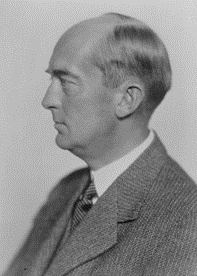
At the same time he handled a range of responsibilities being Head of the Swedish Museum of Natural History and Head of the Department of Palaeobotany, and he was Vice-Secretary at the Swedish Academy of Science.
Halle was an appreciated colleague, not only because of his carefulness and self-criticism, but also because of his tolerance and tactful manner with people around him. His most important scientific efforts are found in palaeobotanical investigations of morphology, anatomy and biostratigraphy of floras.
Scientifically work
Some of his most important works include "Palaeozoic Plants from Central Shansi" published in 1927, along with his Ph.D.-thesis " On the geological structure and history of the Falkland Islands" (1911), Lower Devonian plants from Röragen in Norway" (1916) and "The Mesozoic flora of Graham Land" (1913) all which have an important impact on the development of palaeobotany. Halle also made considerable efforts within the area of morphology and he developed the investigation methods of palaeobotany.
In a tribute on the 60th birthday of Halle, Florin (1948) states “The great quality the work of Halle is known among Palaeobotanists. With great technical inventiveness and skill... combined with critical attitude towards himself and his work, he must be regarded as one of the most important scientists in the 20th century with respect to the development of palaeobotany...With his extraordinary human qualities Thore Halle was well liked, respected, and highly esteemed among his colleagues".
Growth, education and career
Thore Gustaf Halle was born the 25th of September 1884 in Nykyrka close to Mullsjö in the county of Västergötland, Sweden. His mother was Eva Cornelia Larsson and his father was the shopkeeper Carl Otto Gustafson. He went to Elementary school in Gunnarsbo, Nykyrka, and began his academic career at the secondary grammar school of Jönköping.

Higher levels of educations
During this time Halle developed a strong interest in science, especially in botany. In 1903 he began study at the University of Uppsala and 1905 he published his first scientific article "Bidrag till Hökensåsbygdens mossflora". In 1906 he graduated as Bachelor of Science with geology as the main subject.
Development of the Quaternary flora of Sweden
He participated at the lectures of Docent Rutger Sernander and became interested in the development of the Quaternary flora of Sweden and postglacial climate. In 1906 he published an article on a small investigation of calcareous sediments in the parish of Fröjels on the island of Gotland.
Through his studies of the calcareous sediments Halle came in contact with professor A. G. Nathorst at the Department of Fossil Plants and Archaegoniates (present Department of Palaeobotany) at the Swedish Museum of Natural History. This contact led to the engagement of Halle in investigations at the department by 1907.
The Swedish of Natural History
The first works considered club mosses of the Palaeozoic (1907) and horsetails of the Mesozoic (1908). It is interesting to note that Nathorst, like Halle, had an early interest in the postglacial flora of Sweden. 1911 he received the title Doctor of Philosophy at the University of Uppsala and he same year he was appointed docent at the University of Stockholm.
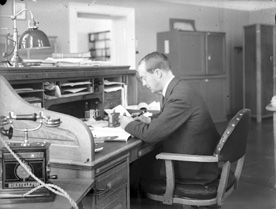
The first years Halle was fee-remunerated at the department and 1914 he was hired as scientific help and later as assistant.Nathorst retired in 1917 and the 22nd of February the following year Halle was appointed professor and the successor of Nathorst at position as Head of the Department, which was now situated at its present site, in Frescati, to the north of Stockholm.
Halle was in addition to this, also the head of the museum from 1921 until 1947. He retired in 1950 and his successor was Olof Hugo Selling. In 1930 Halle was appointed Doctor of Honour at the University of Cambridge and 1939 he became Vice-Secretary of the Swedish Academy of Science.
Mosses, Quaternary geology and flora
As mentioned Halle was initially interested in the Quaternary flora of Sweden and he published a few articles on the subject (e.g. Halle 1915), including the above mentioned on calcareous sediments on Gotland. This interest extended to other parts of the world, for example, “On quaternary deposits and changes of level in Patagonia and Tierra del Fuego" (Halle 1910).
As a bryologist Halle is mostly famous as a collector. He took part in the collection of more than 10 000 samples, now kept at the Department of Cryptogamic Botany at the Swedish Museum of Natural History. He made collections all over Sweden, but mainly in the area of Stockholm. Halle was especially interested in aquatic mosses (Krusenstjerna, 1964).
Two other palaeobotanists at the Swedish Museum of Natural History, Hjalmar Möller and Rudolf Florin, shared the same interest of the moss flora. Möller eventually went on full time to the study of mosses (Krusenstjerna, 1964). The only published contribution by Halle in this area was “Bidrag till Hökensåsbygdens mossflora" (1905), published under his birth name Gustafsson.
Together with the collections of Florin and Möller, Halles collections of more than 10 000 samples are of great importance, especially for the first mapping of the moss flora of the Stockholm area (Krusenstjerna, 1964)
Palaeobotanical work
Halle´s knowledge was extended to most areas of palaeobotany. They were geological as well as biostratigraphical and morphologically. As mentioned, the subject of the first palaeobotanical publication of Halle was on herbaceous club mosses from Palaeozoikum and Mesozoikum, published in Arkiv för Botanik 1907. The studied material originated from e.g., Zwickau in Sachsen, Bjuv and Skromberga in Scania. The following year he published an article on Mesozoic horsetails, using material from e.g., Höör, Bjuv and Stabbarp in Scania. He described the new genera Neocalamites and new species of Equisetites. Halle mentions the flora of Scania in other publications, e.g., descriptions of Mesozoic fossil floras in the southeast of Scania (1913, together with Hjalmar Möller).
In 1916 Halle described plants from the Lower Devonian of Röragen, Norway. Lundblad (1969a, 1969b) describes these works as a starting point to an intense period of studies on the oldest land plants and their morphology. Andrews (1980) found it an important work on the early vascular land plants. The work contains morphological descriptions of psilophytes and a discussion on their phylogeny. The psilophytes became important to Halle who was one of the first to advocate Zimmermans telome theory.
Most of his work contains evidence on his qualities as a morphologist and developer of methods. Further examples on morphological and anatomical investigations are, e.g., “The morphology of Whittleseya and related forms" (1931) and "The structure of certain fossil spore-bearing organs believed to belong to the Pteridosperms" (1933). Walton (1966) mentions the importance of the techniques of Halle in the latter publication, used on the harder, more resistant carboniferous material. The techniques made it possible to e.g., distinguish the position of pollen in the complex organs that produced them (Andrews, 1980), which earlier have not been possible. With the same publication in mind Lundblad (1969a) describes his reconstructions of the reproductive organs of the pteridosperms as classical.
The last great work by Halle was “De utdöda växterna" (1938-1940) in Carl Skottsbergs "Växternas liv" and has the characteristic of a Swedish textbook on palaeobotany and is unique of its kind. Lundblad (1969a, 1969b) and Andrews (1980) were both sorry that these works never were translated into some of the great cultural languages.
Palaeobotanical activities in the Antarctic and South America
In 1901-1903 Otto Nordenskjöld led a Swedish expedition to the Antarctic. One of the scientific staff members was the geologist Johan Gunnar Andersson (1874-1960), later famous and known in Sweden as “China-Gunnar". He found and collected a black shale with a lot of fossil plant impressions at Hope bay, Graham Land that Halle investigated and found to be Jurassic in age, published in “The Mesozic Flora of Graham Land" (1913).
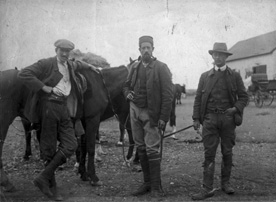
In 1907-1909 Halle participated himself on an expedition to South America, led by Carl Skottsberg. Halle collected plant fossils in the Tierra del Fuego, Falkland Islands, Brazil, Chile and Patagonia. In the Falkland Islands he discovered a Glossopteris Flora, described in his PhD thesis “On the geological structure and history of the Falkland Island" (1911). The geological description also contains the sensational discovery of tillite as witness of a glaciation in the Permian-Carboniferous periods. Already at this time Halle made proof of his capability in combined palaeofloristic and geological studies.
Cooperation with China-Gunnar Johan Gunnar "Kina-Gunnar" Andersson became in 1914 the Chinese government´s "adviser in mine affairs" and managed to inspire Halle to mount a research expedition to the provinces of Hebei, Jiangxi and Henan. Halle made extensive collections, collected by himself, China-Gunnar and Chinese geologists. The transport of this material to Sweden ended in a disaster when the ship, the Swedish steamer “Peking" went shipwrecked in a typhoon at the Chinese Sea 1919 and the whole of the collection was lost.
China-Gunnar managed, at least partly, to replace the lost specimens in cooperation with the Chinese Geological Survey, and these new collections arrived safely to Halle in Stockholm. He also received specimens from Erik Norin (1895-1982). Norin made collections in China during the year 1921-1922 on the invitation of professor Erik T. Nyström at the University of Shanxi. Lundblad (1969a) states that Halle used this collection as a base in his great work "Palaeozoic plants from Central Shansi" (1927), which is basic to the knowledge on the Permo-Carboniferous floras of China. Andrews (1980) stated “Halle´s greatest single publication is his monumental volume on the Palaeozoic plants from Central Shansi". An assertion supported by the careful documentation of the collection where all specimens are located to individual beds.
References
Andrews, H. N., 1980. The fossil Hunters. In Search of Ancient Plants. Cornell University Press. London. 421pp.
Florin, R., 1948. Thore Gustav Halle Zum sechzigsten Geburtsdag. Palaeontographica 88(B4-6): V-IX.
Gustafson, T., 1905. Bidrag till Hökensåsbygdens mossflora. Arkiv för botanik 4(11): 1-32.
Halle, T. G., 1906. En fossilförande kalktuff vid Botarfve i Fröjels socken på Gotland. Geologiska Föreningens i Stockholms Förhandlingar 28(1): 19-54.
Halle, T. G., 1907. Einige Krautartige Lycopodiaceen Paläozoischen und Mesozoischen Alters. Arkiv för Botanik 7(5): 1-17.
Halle, T. G., 1908. Zur Kenntnis der Mesozoischen Equisetales Schwedens. Kungliga Svenska Vetenskapsakademiens Handlingar 43(1): 1-40.
Halle, T. G., 1910. A Gymnosperm with Cordaitean-like leaves from the Rhaetic Beds of Scania. Arkiv för Botanik 9(14): 1-7.
Halle, T. G., 1910. On the Swedish species of Sagenopteris Presl and of Hydropterangium nov. gen. Kungliga Svenska Vetenskapsakademiens Handlingar 45(7): 1-16.
Halle, T. G., 1911. On the geological structure and history of the Falkland Islands. Bulletin of the Geological Institution of University of Uppsala 11: 115-229.
Halle, T. G., 1913. The Mesozoic flora of Graham Land. Wissenschaftliche Ergebnisse der Schwedischen Südpolar-Expedition 1901 - 1903 unter Mitwirkung zahlreicher Fachgenossenen 3(14): 1-123. Generalstabens litografiska Anstalt. Stockholm.
Halle, T. G., 1915. Some xerophytic leaf-structures in Mesozoic plants. Geologiska Föreningens i Stockholm Förhandlingar 37(5): 493-520.
Halle, T. G., 1916. Lower Devonian plants from Röragen in Norway. Kungliga Svenska Vetenskapsakademiens Handlingar 57(1): 1-46.
Halle, T. G., 1921. On the sporangia of some Mesozoic ferns. Arkiv för Botanik 17(1): 1-28.
Halle, T. G., 1927. Palaezoic Plants from Central Shansi. Palaeontologica Sinica Series A 2(1): 1-316.
Halle, T. G., 1931. The morphology of Whittleseya and related forms. Fifth International Botanical Congress in Cambridge. Report of Proceedings: 472.
Halle, T. G., 1933. The structure of certain fossil spore-bearing organs believed to belong to the Pteridosperms. Kungliga Svenska Vetenskapsakademiens Handlingar 12(6): 1-103.
Halle, T. G., 1938-1940. De utdöda växterna. Del 1. I Skottsberg, C. (red.). Växternas liv 4: 445-667. Nordisk familjeboks förlags AB. Stockholm.
Halle, T. G., 1938-1940. De utdöda växterna. Del 2. I Skottsberg, C. (red.). Växternas liv 5: 1-136. Nordisk familjeboks förlags AB. Stockholm.
Krusenstjerna, E. von, 1964. Stockholmstraktens bladmossor. P. A. Norstedt & Söner. Stockholm. 129pp.
Lundblad, B., 1969a. Utvecklingslinjer i svensk paleoboanik 1870-1945. Fauna och flora 64: 269-281.
Lundblad, B, 1969b. Halle, Thore Gustaf. I Svenskt biografiskt lexikon 18: 15-18.
Möller, H. and Halle, T. G., 1913. The fossil flora of the coal-bearing deposits of South-Eastern Scania. Arkiv för Botanik 13(7): 1-45.
Norin, E., 1922. The Late Palaeozoic and Early Mesozoic Sediments of Central Shansi. Bulletin of the Geological Survey of China 4: 1-80.
Skottsberg, C., 1909. Båtfärder och vildmarksridter: minnen från en forskningsfärd genom Patagonien och Eldslandet. Stockholm. 374pp
Walton, John, 1966. Thore G. Halle. The Year Book of the Royal Society of Edinburgh 1966: 20-22.