
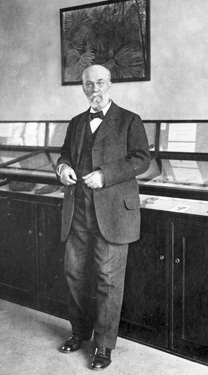
Alfred Gabriel Nathorst (1850-1921)
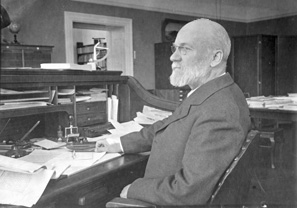
Alfred Gabriel Nathorst, scientist, researcher and explorer had a broad range of knowledge within natural sciences, something seldom seen today.
Thore G. Halle writes in his memorial sketch of Nathorst 1921 “Nathorst is in some cases a late representative of the Linnaean type of researcher, and his scientific activity was so variable that most likely there is no one today capable of depicting all these aspects".
Important achievements
His most important achievements were made in various areas of palaeobotany, geology and botany. One of the most significant was the development of the world-class collections in the Department of Palaeobotany at the Swedish Museum of Natural History in Stockholm, Sweden.
Nathorst was the first head of the department, established in 1884, and stayed on until his retirement in 1917, during this time his collection laid the foundation of the collections. Eighty years after his death a significant part of the collection is a result of collecting by himself, or in collaboration with other important luminaries, e.g., A. F. Carlson and F. J. Blomquist (Scania), H. L. Norberg (Spitsbergen) och P. Dusén (Africa and South America).
Nathorst also developed the collections through the acquisition of specimens, e.g., through gifts and trades. To a least the same extent as his contribution to the growth of the collections, his scientific activities has an unsurpassed importance on the knowledge of the collections. Many of his initial detailed investigations are still benchmarks for the taxonomic investigations of floras, in particular these Scania and the Arctic.
Growth, education and career
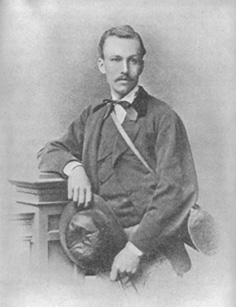
Alfred Gabriel Nathorst was born the 7th of November 1850 in Väderbrunn, Södermanland, Sweden. The Nathorst family originated from England and moved to Sweden via Germany in the 16th century.
His mother was Maria Charlotta (Melitte af) Georgii (1825-1869) and his father Hjalmar Otto Nathorst (1821-1899) was an agronomist and head of the agricultural college of the county of Södermanland, a position that also his grandfather Johan Teofil Nathorst (1794-1862) had held.
Malmö and Lund
In 1861 the father was called to a professorship in Alnarp, Scania and the family moved along with him. The main part of Alfred´s schooling took place at the secondary grammar school in Malmö. In 1868 Alfred Gabriel Nathorst started his studies at the university of Lund. The plan was to study botany, but the same year he met Nils Peter Angelin (1805-1876) who invited him to take part in fieldwork during the summer.
This meeting with Angelin, and their work, made Nathorst change direction of his studies towards geology. At that time, there was nobody teaching geology at the University of Lund, but Otto Torell (1828-1900) who was a master of zoology, taught geology to the young Nathorst. After studies in Uppsala 1871-1873 where he gained his bachelor degree, Nathorst returned to Lund to study for a PhD and he became a docent in 1874.
Publications
The trip with Angelin during the summer of 1868 led to his first scientific publication in 1869, "Om lagerföljden inom kambriska formationen vid Andarum i Skåne".This was the first in a long series of geological investigations and publications made by Nathorst, especially on the geology of Scania and the Arctic area which captured his interest.
In 1873 Nathorst became assistant geologist at the Swedish Geological Survey and in 1877 the assistant of Torell, who was now head of the Swedish Geological Survey. When Torell retired Nathorst hoped to became his successor, but he was never offered the position because of a perceived serious disability, his bad hearing.
Curator of a new Department
In a royal decree the 5th of December 1884 Nathorst received the title of professor and was appointed by the Royal Swedish Academy of Sciences as curator of the new “Department of Archegoniates and Fossil Plants", the present Department of Palaeobotany at the Swedish Museum of Natural History. A position he held until his retirement in1917. The department was until 1915 located in a governmental building in the cross road Wallingatan/Holländargatan in Stockholm. The department then moved to the new and present building at Frescati, north of Stockholm city.
The first polar expedition
In the summer of 1870, together with Hjalmar Wilander (1844-1891), Nathorst visited Svalbard. The cause to this expedition was the observation of Phosphorite in 1864 at Kapp Thordsen made by Adolf Erik Nordenskiöld (1832-1901). The layers with Phosphorite was investigated and a report given to Nordenskiöld.
During the expedition Nathorst also made observations on the Arctic flora and found plant fossils of Carboniferous age, close to Gipshuken. In 1871 he published an article in Botaniska Notiser "Om vegetationen på Spetsbergens västkust". After his expedition to Svalbard Nathorst made several investigations on postglacial Arctic plants remnants in Scania and Denmark.
In 1872 he visited Germany, Switzerland and England to study glacial plants remnants. During his long carrier he investigated and published several articles on the subject. The first was published in the Year Book of the University of Lund "Om några arktiska vextlämningar i en sötvattenslera vid Alnarp i Skåne" (1871).
Fossil floras of Scania
During his stay in Switzerland Nathorst met the Suisse botanist and palaeobotanist Oswald Heer (1809-1883). Heer had since many years been describing the collection of Adolf Erik Nordenskiöld from the Arctic, (for example Svalbard and Greenland). Nordenskiöld was also informed about the presence of plant fossils in Bjuv and in Pålsjö in Scania during a visit there in 1873. He was given fossils as a gift and he also made his own collections.
Nordenskiöld suggested and inspired Nathorst into describing the fossil flora of Scania and started a long cooperation with Heer. In 1875 the first descriptions were published in the Geologiska Föreningens i Stockholm Förhandlingar Förhandlingar, "Fossila växter från den stenkolsförande formationen vid Pålsjö i Skåne".
His own collection
The same year Nathorst him self began collecting fossil plants from the coal formation in Scania. He visited Helsingborg, Tinkarp, Sofiero, Pålsjö och Höganäs. To his help he had a very competent layman, an employee at the coal mines, A. F. Carlson, who mainly through private interest, cooperated and collected plant fossils for Nathorst.
Later, 1903-1905 he also had help from the foreman F. J. Blomquist. These three gentlemen were responsible for almost 5 000 of the around 25 000 specimen from the coal formation in Scania, housed in the Swedish Museum of Natural History. With a special governmental grant Nathorst was able to work with the collections, he, A. F. Carlson and others had collected. The work resulted in three comprehensive papers:
- Bidrag till Sveriges fossila flora 1. Växter från den rätiska formationen vid Pålsjö i Skåne (1876),
- Bidrag till Sveriges fossila flora 2. Floran vid Höganäs och Helsingborg (1878)
- Om floran i Skånes kolförande bildningar. Floran vid Bjuf (1878-86).
Fossil floras of Japan
During his famous Vega expedition 1878-1879 Nordenskiöld collected a large number of fossils in Japan and Nathorst was given additional tasks, to determine and describe this plant fossils from Japan resulting in "Bidrag till Japans fossila flora" (1882) och "Zur fossilen Flora Japans" (1888).
Further polar expeditions
In 1882 Nathorst went on his second polar expedition, this time along with Gerhard de Geer, once again to Svalbard. The expedition studied the geology in the area around Isfjorden and the main purpose was to study the Heckla Hook Formation. The expedition also made geographical studies and considerable amounts of fossils were collected.
During the following year, 1883, Nathorst became second leader on the expedition of A. E. Nordenskiöld to western Greenland. Nathorst made a number of botanical investigations at Wajgattet (Vaigat) and Atanekerdluk. He also brought home a large number of fossil plants and made important stratigraphical discoveries.
Both these expeditions contributed to the descriptions of the Arctic flora and became an important continuation of the extensive work of Heer. Nathorst published several important papers including
- Ueber die wissenschaftligen Resultate der letzten schwedischen Expedition nach Spitsbergen (1883)
- Grönlands forntida växtvärld (1884)
- Zur fossilen Flora der Polarländer, an assembly of several articles (1894-1920)
Nathorsts own Polar expeditions
After a long preparation and with extensive scientific planning Nathorst carried out his own expedition in 1898 to Björnön, Svalbard and Kung Karls Land. The result was a number of scientific articles in various subjects. The contribution of Nathorst was mainly geological and palaeontological, for example Über die oberdevonische Flora (die Ursaflora) der Bären insel."(1900), "Bidrag till Kung Karls Lands geologi" (1901) and "Beträige zur Geologie der Bären Insel, Spitzbergens und des König-Karl-Landes"(1910).
The ship that was used was “Antarctic", whish he also used for his second own expedition the following year, 1899. This time to Greenland with one purpose, among other, to look for traces from the balloon expedition of Andrée, but no signs of the Andrée expedition was found. The scientific investigations were mainly geographical.
The expedition reached and mapped for example Kejsar Frans Josefs Fjord och Kung Oscars Fjord, the mapping was led by the botanist and cartographer Per Dusén (1855-1926). Nathorst made geological investigations and, among other things, he recognized that the Silurian and the Devonian systems were present in the eastern part of Greenland.
"Bidrag till nordöstra Grönlands geologi"(1901) and "Die kartographischeund geologische Aufnahme des Kaiser Franz-Joseph-fjord und des König Karls-Fjords in Nordostgrönland"(1902) are two examples of articles as a result of the expedition. The “Antarctic" later was used on the historic and dramatic Swedish South Polar Expedition of Otto Nordenskjöld in 1901-1903.
Morphological and systematic work
Later Nathorst also entered deeply into morphological and systematic studies resulting in several detailed descriptions of fossil plants, e.g., the genera of Dictyophyllum, Camptopteris, Lycostrobus och Palyssia.
Other scientific efforts
A very important effort that was made by Nathorst is the development of the maceration technique and he inspired others to use this technique in order to make preparations of plant fossils. He was also active in correspondence with colleagues all over the world.
Nathorsts interest in botany did not have much space by the side of palaeobotany and geology, but despite this he wrote several articles on the subject as mentioned above, other examples are "Nya bidrag till kännedomen om Spetsbergens kärlväxter och des växtgeografiska förhållanden"(1883) and "Botaniska anteckningar från nordvästra Grönland"(1884).
Hunting was another of Nathorsts interests , which he practiced along with zoological studies, for example "De hvita polarvargens invandring till nordöstra Grönland" (1899) and "Om myskoxen och myskoxjagter på Ostgrönland 1899" (1900). Further another subject that Nathorst dealt with was the so-called fossil algae.
This was the subject of his Ph.D. thesis and another article was published in 1880 "Om spår av några evertebrerade djur m. m. och deras paleontologiska betydelse".
Epilogue
Nathorst was an internationally very respected scientist and he received several distinctions, but as Professor T.G. Halles writes in his memorandum “They (the distinctions) will anyway disappear in comparison with the monument Nathorst built up for himself in Palaeobotanical Department at the Swedish Museum of Natural History and in his scientific production".
Henry N. Andrews writes in his book “The Fossil Hunters": “We thus meet at this point one of the greatest figures in the history of fossil botany". The impact of Nathorst on the palaeobotanical collections at the Swedish Museum of Natural History can never be overrated.
After more than 80 years, still a considerable part of the collections is the result of his own collecting or acquisitions (gifts and trades), or through collections made by his collaborators. The importance of Nathorsts scientific work lies in the foundations that it laid for future geological and palaeontological advances, yet many of his numerous and authoritative primary descriptions of taxa still stand today.
References
Andrews, H. N., 1980. The Fossil Hunters. In Search of Ancient Plants. Cornell University Press. Ithaca and London. 421pp
Halle, T. G., 1921. Alfred Gabriel Nathorst. En minnesanteckning. Geologiska föreningens Förhandlingar 43(3-4): 241-280.
Halle, T. G., 1921. Förteckning på A. G Nathorst s skrifter 1869-1920. Geologiska föreningens i Stockholm Förhandlingar 43(3-4): 281-311.
Hofberg, H., Heurlin, F., Millqvist, V. och Rubensson, O., 1906. Svenskt Biografisk Handlexikon. Albert Bonniers Förlag. Stockholm.
Liljequist, G. H., 1993. High Latitudes. A History of Swedish Polar Travels and Research. The Swedish Polar Research Secretariat and Streiffert. Stockholm. 607pp
Lundblad, A. B., 1984. Stenherbarier i norr - om grundandet av Riksmuseets paleobotaniska avdelning för 100 år sedan. Flora och Fauna 79: 145-152.
Nathorst, A. G., 1869. Om lagerföljden inom cambriska formationen vid Andrarum i Skåne. Öfversigt af Kongl. Vetenskapsakademiens Förhandlingar 26: 61-65.
Nathorst, A. G., 1871. Om några arktiska vextlämningar i en sötvattenslera vid Alnarp i Skåne. Lunds Universitets årsskrift 7. 17pp.
Nathorst, A. G., 1871. Om vegetationen på Spetsbergens västkust. Botaniska Notiser 1871: 105-117.
Nathorst, A. G., 1875. Fossila växter från den stenkolsförande formationen vid Pålsjö i Skåne. Geologiska Föreningens i Stockholm Förhandlingar 2: 373-392.
Nathorst, A. G., 1876. Bidrag till Sveriges fossila flora. Växter från rhätiska formationen vid Pålsjö i Skåne. Kungliga Svenska Vetenskapsakademiens Handlingar 14(3). 82pp.
Nathorst, A. G., 1878a. Om floran i Skånes kolförande bildningar 1. Floran vid Bjuf, första häftet. Sveriges Geologiska Undersökning C 27: 1-52.
Nathorst, A. G., 1878b. Bidrag till Sveriges fossila flora 2. Floran vid Höganäs och Helsingborg. Kungliga Svenska Vetenskapsakademiens Handlingar 16(7). 53pp.
Nathorst, A. G., 1879a. Om floran i Skånes kolförande bildningar 1. Floran vid Bjuf, andra häftet. Sveriges Geologiska Undersökning C 33: 53-82.
Nathorst, A. G., 1882. Bidrag till Japans fossila flora. Vegaexpeditionens vetenskapliga arbeten 2: 119-225.
Nathorst, A. G., 1883. Ueber die wissenschaftligen Resultate der letzten schwedischen Expedition nach Spitsbergen. Verhandlungen k. k. Geol. Reichsanst. in Wien: 25-28.
Nathorst, A. G., 1883. Nya bidrag till kännedomen om Spetsbergens kärlväxter och dess geografiska förhållanden. Kungliga Svenska Vetenskapsakademiens Handlingar 20(6). 88pp
Nathorst, A. G., 1884. Botaniska anteckningar från nordvästra Grönland. Öfversigt af Kongl. Vetenskapsakademiens Förhandlingar 41(1): 13-48.
Nathorst, A. G., 1884. Grönlands forntida växtvärld. Nordisk Tidskrift 7: 344-363.
Nathorst, A. G., 1886. Om floran i Skånes kolförande bildningar 1. Floran vid Bjuf, tredje häftet. Sveriges Geologiska Undersökning C 85: 83-116.
Nathorst, A. G., 1888. Zur fossilen Flora Japans. Palaeontologische Abhandlungen 4 (3): 195-250.
Nathorst, A. G., 1894. Zur paläozoischen Flora der arktischen Zone, enthaltend die auf Spitzbergen, auf der Bären Insel und auf Novaja Semlja von den schwedishen Expeditionen entdeckten paläozoischen Pflanzen. Kungliga Svenska Vetenskapsakademiens Handlingar 26(4). 80pp
Nathorst, A. G., 1894. Zur fossilen Flora der Polarländer. Teil 1, Lief 1. P. A. Norstedt & Söner. Stockholm. 80pp
Nathorst, A. G., 1897. Zur mesozoischen Flora Spitzbergens gegründet auf die Sammlungen der schwedischen Expeditionen. Kungliga Svenska Vetenskapsakademiens Handlingar 30(1). 77pp
Nathorst, A. G., 1897. Zur fossilen Flora der Polarländer. Teil 1, Lief 2. P. A. Norstedt & Söner. Stockholm. 77pp
Nathorst, A. G., 1899. Den hvita polarvargens invandring till nordöstra Grönland. Svenska Jägarförbundets nya tidkrift 37: 235-242.
Nathorst, A. G., 1900. Über die oberdevonische Flora (die Ursaflora) der Bären-Insel. (Vorläufige Mitteilung). Bulletin of the Geological Institution of the University of Uppsala 4: 152-156.
Nathorst, A. G., 1900. Om Myskoxen och myskoxjagter på Ostgrönland 1899. Svenska Jägarförbundets nya tidkrift 38: 2-28.
Nathorst, A. G., 1901. Bidrag till Kung Karls Lands geologi. Geologiska Föreningens i Stockholm Förhandlingar 23: 341-378. Nathorst, A. G., 1901. Bidrag till nordöstra Grönland geologi. Geologiska Föreningens i Stockholm Förhandlingar 23: 275-306.
Nathorst, A. G., 1902. Zur oberdevonischen Flora der Bären Insel. Kungliga Svenska Vetenskapsakademiens Handlingar 36(3). 60pp
Nathorst, A. G., 1902. Zur fossilen Flora der Polarländer. Teil 1, Lief 3. P. A. Norstedt & Söner. Stockholm. 60pp
Nathorst, A. G., 1902. Die kartographische und geologische Aufnahme des Kaiser Franz-Josef-Fjords und des König Karls-Fjords in Nordostgrönland 1899. Vierteljahrshefte f. d. Geograph. Unterricht. Jahrg. 2: 1-18.
Nathorst, A. G., 1910c. Beträige zur Geologie der Bären Insel, Spitsbergens und des König-Karls-Landes. Bulletin of the Geological Institution of the University of Uppsala 10: 261-416.
Nathorst, A. G., 1914. Zur fossilen Flora der Polarländer. Teil 1, Lief 4. Nachträge zur paläozoischen Flora Spitsbergens. P. A. Norstedt & Söner. Stockholm. 110pp
Nathorst, A. G., 1916. Paleobotaniska afdelningen. I Naturhistoriska Riksmuseets Historia. Dess uppkomst och utveckling. Kungliga Vetenskapsakademien. Stockholm. 290pp
Nathorst, A. G., 1920. Zur fossilen Flora der Polarländer. Teil 2, Lief 1. Zur Kulmflora Spitsbergens. P. A. Norstedt & Söner. Stockholm. 45pp
